Pages

Showing posts with label sanccob. Show all posts

24 May 2019

African penguin research project begins at Boulders Penguin Colony

SOUTH AFRICA – In the last week of May, a much-anticipated research project will start at Boulders Penguin Colony in Simonstown. The African penguin movement ecology research project will take place over the penguins' breeding season from May to September 2019.

“The study is being led by the FitzPatrick Institute of African Ornithology from the University of Cape Town and SANCCOB. The partnership will see a collaboration between these two organisations and South African National Parks – Cape Research Centre to conduct the study,” said Dr Alison Kock, Marine Biologist: Cape Research Centre.

15 November 2017

Experts team up on study to save endangered African penguins

SOUTH AFRICA – With less than 25,000 breeding pairs in existence today, it is an uphill battle for South Africa's African penguin. The 60% drop in their population since 2001 has put them on the International Union for Conservation of Nature's endangered species list. In some colonies, the drop in population has been as high as 80%. Competition with fisheries, oil spills, climate change, diseases and predators are all contributing factors in their dramatic decline.

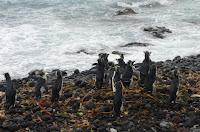
African penguins.
Photo credit: Ralph E.T. Vanstreels, D.V.M., Ph.D
To preserve this species and optimise rehabilitation efforts, epidemiologist Adam Schaefer from Florida Atlantic University in the USA joined forces with scientists Nola Parsons and Ralph Vanstreels from the Southern African Foundation for the Conservation of Coastal Birds (SANCCOB). The facility, located near Cape Town, South Africa, receives more than 900 African penguins for rehabilitation each year. While the success rate for the overall release of these penguins back into the wild is about 75%, limited data exists on the factors that contribute to their successful rehabilitation.

To better understand how to improve the rehabilitation of African penguins, the researchers conducted a first-of-its-kind study on prognostic health indicators such as body mass, blood analysis, and infectious disease exposure. For the study, they analysed 3,657 adult African penguins that were admitted to the SANCCOB facility for rehabilitation between 2002 and 2013.

26 February 2017

New guidance on hand-rearing decisions for endangered penguin chicks

African penguin chicks. Photo credit: SANCCOB.
SOUTH AFRICA – Researchers have developed a model to provide guidance on the likelihood of abandoned African penguin chicks surviving after they are admitted to rehabilitation.

Developed by researchers from the Universities of Bristol, Exeter and Cape Town, the Southern African Foundation for the Conservation of Coastal Birds (SANCCOB) and Bristol Zoological Society, it is the first model of its kind.

The use of rehabilitation for conservation is growing worldwide, with many research papers monitoring the success of individuals after their release. Rearing chicks that are unlikely to survive naturally could significantly contribute to the conservation of threatened bird species such as the African penguin.

24 October 2014

Rescued 'abandoned' penguin chicks' survival similar to colony rates

SOUTH AFRICA - Abandoned African penguin chicks that were hand-reared and returned to the wild showed a similar survival rate to their naturally-reared counterparts, according to a study published on 22 October 2014 in the open-access journal PLoS ONE by Richard Sherley from University of Cape Town and colleagues.

The endangered African penguin population has been rapidly decreasing since 2001. In the Western Cape of South Africa, penguins breed from February to September and moult between September and January, once chicks have fledged. If adult penguins begin the moulting process, a 21-day period where they no longer have the waterproofing necessary to dive for food, with chicks in the nest, the chicks may starve. 

Southern African Foundation for the Conservation of Coastal Birds (SANCCOB) recovers 'abandoned' penguin chicks that are no longer being fed and cares for them until they can be reintroduced into breeding colonies. 

Researchers documented the care, release and survival of over 840 hand-reared chicks in 2006 and over 480 hand-reared chicks in 2007. Of those admitted, in 2006, 91% and, in 2007, 73% were released into the wild. Post-release juvenile and adult survival rates were similar to recent survival rates recorded for naturally-reared birds. 

08 February 2012

Tristan's penguins one year on

The first treated penguins are released
in April 2011. Photo by Katrine Herian/
The RSPB.
TRISTAN DA CUNHA - Almost a year since thousands of endangered penguins' lives were threatened by an oil spill on Nightingale Island (part of Tristan da Cunha, a UK Overseas Territory in the South Atlantic) a survey to assess the birds' population has taken place.

When the bulk carrier MS Oliva ran aground on 16 March last year, a huge effort to rescue the penguins was launched. The ship was travelling from Brazil to Singapore with a cargo of 65,000 tonnes of soya beans and 1,500 tonnes of bunker fuel when it ran aground.

As the ship broke up in the rough seas, the soya and oil were discharged into the waters around Nightingale. In the days that followed, the oil reached Inaccessible Island, a World Heritage Site, and Tristan more than 30 km away.

With the group of islands being home to over 65 per cent of the global population of endangered northern rockhopper penguins, Tristanians (residents of Tristan da Cunha) and the Tristan Conservation Department, followed by staff from the RSPB and Southern African Foundation for the Conservation of Coastal Birds (SANCCOB), came together and moved quickly to collect and clean up the oiled birds and prevent many more from coming into contact with the oil.

Although efforts to rescue and rehabilitate the penguins were huge, it has been unknown until now just how much the rockhopper population has been affected by the spill. While results from the latest counts suggest the breeding population hasn't suffered as much as anticipated, scientists are warning that the news should be met with caution.

Dr Juliet Vickery, the RSPB's head of international research, said, "It's a big relief that the initial results of the counts are better than we had anticipated. We should not, however, relax our watch. There is much we don't know about this species and the extent to which breeding colony counts reveal the true picture of population trends is hard to ascertain.

"Though immediate impact is not as bad as we feared, there may be longer term sub-lethal effects reducing breeding success, so it is vital that we continue to monitor the birds closely for several more years to establish the true impact of the oil spill."

Estimations show approximately 154,000 penguins bred on the island in 2011 but estimates in the 1950s suggest there were "millions" of birds, with two million pairs on Gough alone. The species remains globally threatened and the causes of the historic decline remain unknown.

After the disaster, the RSPB launched an emergency appeal to raise funds to help with the clean up. The appeal has raised almost £70,000 and will be used to support penguin monitoring, strengthen the island's biosecurity, and facilitate rodent control on Tristan to reduce risk of rats being introduced to Nightingale.

Katrine Herian works for the RSPB on the island, was involved in the clean-up mission last year, and helped carry out the counts. She said, "Something really needs to be said about the huge Tristanian efforts in response to this disaster - without them, this could have been a very different story.

"While the true impact of the spill won't be known for some time yet, we can at least know that everything that could be done was done."

Read related posts

Source
First assessment of endangered UK penguins since oil spill, 6 February 2012, RSPB press release

21 July 2011

Lucy the penguin plots historic course

SOUTH AFRICA - On 26 June 2011, Lucy the penguin made history as she became the first ever juvenile African penguin to be fitted with a satellite transmitter. The information gained from Lucy's travels and those of other juvenile penguins may one day help scientists to establish a new African penguin colony.

The release of Lucy, who was born in the wild and then hand-reared by SANCCOB (Southern African Foundation for the Conservation of Coastal Birds), is part of the Chick Bolstering Project (CBP), a collaborative endeavour being undertaken by SANCCOB, the Oceans and Coasts Branch of the Department of Environmental Affairs and the Animal Demography Unit (ADU), University of Cape Town.

The purpose of the project is to investigate the behaviour of juvenile birds and to answer pressing questions about the pressures that they face during early life. One of the goals is to use chicks abandoned by their parents and hand-reared to create new colonies close to areas of high prey abundance.

Over the coming months, four other juveniles will be fitted with transmitters and released. On 15 July, the next one to go, Richie, was fitted with his transmitter and will be given a few days of swimming around in SANCCOB’s pool to get used to it.

For both birds, the transmitters are expected to relay their position for about six months and regular updates will be posted on Penguin Watch. The transmitters are attached to the feathers on the penguins’ backs by a combination of a special tape and glue.

Dr Richard Sherley of ADU, who is heading the research component of the project, said, “Once the tape and glue wear off, the device will simply drop off. Hopefully, by that time we will have learnt some vital lessons about what these young birds do at sea.

“At worst case scenario, the device will drop off when the bird moults at around 18 months after deployment, but based on studies with these devices in the past, we don’t expect the attachment method to last that long.”

SANCCOB veterinarian Dr Nola Parsons, who selected Lucy and Richie for their transmitter missions said on the day of Lucy’s release, “It is wonderful to release this bird which has the potential to give us so much more valuable information about movements of African penguin fledglings. This work is essential in improving the way in which we manage this species.” 

Sources
Hand-reared penguin plots historic course by Richard Sherley and Venessa Strauss, 6 July 2011, Penguin Watch
Second chick set to follow in Lucy's wake by Richard Sherley, 18 July 2011, Penguin Watch

17 July 2011

Tristan's last rehabilitated rockhoppers released

TRISTAN DA CUNHA - Almost three months after the MS Oliva ran aground on Nightingale Island, the rockhopper rescue on Tristan da Cunha is over, with the last 180 oiled northern rockhopper penguins released into the sea on on 21 June. This followed the release of 57 penguins on 12 June.

According to Tina Glass's report on the Tristan da Cunha website, a total of 381 of the original 3718 birds have been safely returned so sea, which is an approximate survival rate of 10%.

Ms Glass said that the reason for the low survival rate is that when the birds were first oiled they were all at the end of their moulting cycle - hungry and thirsty and at their weakest - so, despite huge efforts by Tristan Islanders and experts from SANCCOB and the RSPB, most died.

The low survival rate may be disappointing, but at least this means that nearly 400 penguins who would have died without human intervention are alive and back in the wild where they belong. Hopefully these survivors will return to land in August to breed and bolster the population of this endangered bird.

Thank you, penguin rescuers, for your heroic efforts! 

Source
MS Oliva Tristan-based diary, Tristan da Cunha Association: accessed 16 July 2011

04 May 2011

SANCCOB team leaves penguins in islanders' capable hands

Penguins resting after a swim in the
release pool. Photo by Katrine
Herian/RSPB.
TRISTAN DA CUNHA -The SANCCOB team, along with International Tanker Owners Pollution Federation (ITOPF) staff, departed Tristan da Cunha for Cape Town on 23 April aboard the Ivan Papanin

Island Administrator Sean Burns thanked them all for their help and support. He acknowledged that there was still a lot of work to be done to clean and release the rockhopper penguins, but he was grateful for the resources left behind - both material and financial.

SANCCOB Chief Executive Venessa Strauss told the Cape Argus the six-member SANCCOB response team felt privileged to be able to help: "We had a chance to make a difference."

She said two positive outcomes of the MS Oliva disaster are that the Tristan da Cunha islanders are now fully trained to rehabilitate oiled seabirds, and that they have the equipment ready on the island should another spill occur.

"We left behind skills, knowledge and equipment. That’s the good that came out of this, and the next response [to an oil spill there] will be quicker and more efficient. This has highlighted how important it is for these faraway places to be equipped and [people living there to be] trained."

Ms Strauss acknowledged the high mortality rate - RSPB Project Officer Katrine Herian reported on 17 April that of the 3718 birds admitted to the rehab centre, 2378 had died - but said it was unfortunate that the oiled penguins had just finished moulting and were therefore in a poor physical condition. She added that if it had been a month earlier, it could have been much worse. 

Release pool 

Before the SANCCOB team left they helped with the construction of a release pool, which was completed on 17 April after three days of intensive work. All washed penguins will be brought to the release pool to be swum and fed in the days up until they are released back to sea.

"It has been a logistical challenge getting this facility up and running," said SANCCOB's Logistical Manager Mariëtte Hopley. "We wanted it close to the rehab shed but the ground was too uneven, so we had to relocate."

The release pool is actually two pools, designed so that there constant circulation of freshened water. There are also pebbled areas where the washed penguins can dry off and preen in between swimming and feeding.

While some of the stronger penguins clearly took well to the spacious pools, unfortunately some of the birds struggled with the cold and the swimming, and the stress of this may have contributed to further casualties.

There are now around 446 penguins in total in care. Mr Burns said that the strategy now is to focus additional care and re-rinsing on those remaining, build them up, monitor their feathers and then release when they are ready. While everybody is keen to release the penguins back into the wild, this cannot be rushed as they have to be in good condition for their long voyage.

Nightingale still rodent-free

One of the major concerns when the the MS Oliva crashed was that any rodents aboard the vessel would make their way to the rodent-free Nightingale Island. Thankfully, the team monitoring the bait stations set up on the island for rats have reported that there is no evidence of rodent infestation.

Read related posts

Sources
'Oil spill could have been worse' by John Yeld, 29 April 2011, Cape Argus
MS Oliva clean up operation, Tristan da Cunha Association: accessed 3 May 2011
MS Oliva Tristan-based diary, Tristan da Cunha Association: accessed 3 May 2011
Washed rockhoppers get ready for release, RSPB, 18 April 2011, BirdLife International

15 April 2011

Wash, rinse, dry and repeat for next penguin on Tristan da Cunha

Bath time! A rockhopper penguin
gets washed.
Photo by Tertius Gous/SANCCOB
TRISTAN DA CUNHA - The evening of Saturday 9 April provided a rewarding moment for Tristan's rehab manager Dereck Rogers as the first five northern rockhopper penguins to be washed at the newly erected wash-bay facility were drying off under infrared lights.

Mr Rogers, who has been closely involved with the care of the penguins from the moment the first oiled birds were brought back to Tristan more than two weeks ago, was elated at being able to hold a cleanly washed penguin.

The whole island worked together to ensure the expert staff from SANCCOB had everything they needed to erect the wash-bay facility, post-wash pens and pools. The island plumbers, electricians and carpenters were all on standby to assist with the operation, as well as plant operators for moving equipment and materials. The three large hot water geysers brought by the SANCCOB team have been installed in the wash-bay to heat the water for washing, as have hundreds of metres of piping and cable to link in to the island’s water and electrical supplies.

On Monday 11 April the washing of oiled penguins got well under way as the first islander washing team received training from SANCCOB's Venessa Strauss and Jennie Bancroft. Washing a penguin is a thirty-minute process involving a de-greaser mist, a warm bath of biodegradable soap and anti-septic solution, and a rinse with a high-pressure showerhead. The cleaned penguins are then tagged and put in a recovery pen under infrared lamps to keep them warm while they dry off. They are later moved to small clean pens which have access to a swimming pool, where there are encouraged to swim.

Sixty-four penguins were washed on Monday but SANCCOB’s vet, Tertius Gous, said they were aiming to wash up to a hundred a day once the washing team are in full swing.

Meanwhile, at the holding pens, the feeding teams are hard at work trying to satisfy the hunger of the many oiled penguins waiting to be washed. Penguins at the village swimming pool and in the outside pens are being fed pilchards to build up their strength before undergoing the washing process.

Some of the more lightly oiled penguins at the swimming pool are being "swum" every day, after which their waterproofing is tested. When these penguins satisfy the release criteria of effective waterproofing and sufficient weight, they will be released.

To date 3662 penguins have been admitted to the centre, of which 1577 have died. The first 69 to be washed will hopefully be able to join the 24 penguins released so far.

On Tuesday 12 April more help for the penguins arrived aboard the Russian research/Antarctic supply vessel Ivan Papanin - the fourth vessel chartered by the owners of the MS Oliva and their insurers since the incident. The Ivan Papanin carried the SANCCOB supplies and oil abatement equipment that were not able to be collected prior to the departure of the Svitzer Singapore. Aboard the Ivan Papanin is also a Bell-212 helicopter, which will greatly improve the deployment of the oil abatement teams and equipment into the oiled gulleys and bays on Alex (or Middle) Island, the focus of the clean-up efforts.

Currently there are 28 international responders on the island, including the SANCCOB team, veterinarians, International Tanker Owners Pollution Federation (ITOPF) staff, and oil pollution and salvage response experts. They are working alongside an 80-strong island volunteer force. 

The onset of the southern winter has brought with it gale force winds and rough seas. The adverse weather, while hampering the clean-up response, has broken up the majority of the released oil, although there are still clear signs of pollution around Nightingale. Fortunately the penguins have completed their moult, and the vast majority have left their colonies and gone to sea. They will not return to Tristan until the start of the next breeding season in August.

Read related posts

Sources
Wash and dry for rockhoppers at rehab centre, RSPB, 11 April 2011, BirdLife International
Oliva Tristan Diary, Tristan da Cunha Association: accessed 15 April 2011

08 April 2011

Positive news for Tristan's oiled penguins

The first treated penguins walk back
to their home. Photo by Katrine Herian/
The RSPB.
TRISTAN DA CUNHA - Some good news to report for the penguin rescue operation following the oil spill around Nightingale Island, with the first rehabilitated penguins released back into the wild, the arrival of a team from SANCOBB and vital penguin-cleaning equipment, and the setting up of several funds to help with the emergency.

First Tristan penguins released from rehab

The first 24 northern rockhopper penguins of more than 3,600 admitted to the "rehab centre" on Tristan da Cunha were released back to sea on Sunday 3 April.

"The penguins were selected from the strongest ones, with no visible oil on their outer plumage," said Trevor Glass, Tristan da Cunha Conservation Officer. "Of the many tested to see if they were ready for release, only 24 had perfectly waterproof plumage."

"It was an emotional moment to see these penguins released from captivity and walk into the sea and then swim off among the waves," said Katrine Herian, the RSPB Project Officer on Tristan da Cunha. "The Tristan islanders are putting hundreds of hours of their time into saving the oiled penguins and we hope these are the first of many to be released".

On arrival on Tristan the penguins are stabilised and kept indoors in the rehab shed, after which the fittest ones are moved to an outside pen. From here the cleanest and strongest ones are moved to the island’s swimming pool, which is refilled daily with fresh, unchlorinated water.

So far, 3662 oiled penguins have been admitted to the rehab centre. Since the first batch of 500 were admitted on 23rd March, only 373 have died in rehab, which is a survival rate of 90%. About 25% of the penguins at the centre are currently in the release pool.

SANCCOB team arrives with vital people and equipment

There are still many oiled penguins which require urgent washing. A team from SANCCOB arrived on the tug Singapore on Tuesday 5 April, bringing the specialised equipment and materials needed for cleaning the penguins, as well as vital vitamins and medicines for the rehab centre's intensive care unit and frozen pilchards to feed the penguins. Their arrival had been frustratingly delayed by rough seas.

The SANCCOB team were impressed with the set up at the rehab centre and praised the islanders’ efforts under difficult conditions and with very limited resources. 

The specialist cleaning equipment will be put into the wash-bay facility, which will be housed in two government containers close to the rehab shed. Hot water geysers, to remove the heavy bunker oil, will be installed for the penguin-washing operation, and infrared lights will be installed in a drying room. Outside, large tanks will collect and separate the waste-oil/solids and grey water from the washing process. SANCCOB logistics manager Mariëtte Hopley reported the washing facility would be up and running on Friday, when training would begin for islanders in the washing of penguins.

Funds set up to help the penguins

Thanks largely to the efforts of the Ocean Doctor, Dr David Guggenheim, the penguin rescue operation has been picked up by the US media, including CNN, which interviewed Dr Guggenheim (see below) and ran a story on 3 April. The more attention the media give to their plight, the more help the penguins will get!


There are now several funds set up to help with the rehabilitation of the penguins and other wildlife affected by the oil spill:
I realise these are tough economic times for many of us, but if you can spare even a small amount of money to help the penguins, the people working hard to save them on Tristan da Cunha will certainly appreciate it. 

Read related posts

Sources
First Tristan penguins released from 'rehab' by RSPB, 5 April 2011, Birdlife International
MS Oliva oil spill at Tristan da Cunha finally hits the headlines - funding urgently needed for oiled penguin rescue operation, 4 April 2011, The Penguin Lady Blog
Oliva Tristan Diary, Tristan da Cunha Association: accessed 8 April 2011